
Fresh analysis argues that claims of unprecedented borrowing under President Tinubu are misleading, pointing instead to exchange-rate effects and earlier debt accumulation.
Public debate over Nigeria’s debt profile has intensified, with claims that the administration of President Bola Ahmed Tinubu is the country’s biggest borrower since 1999 now being challenged by available data and fiscal analysis.
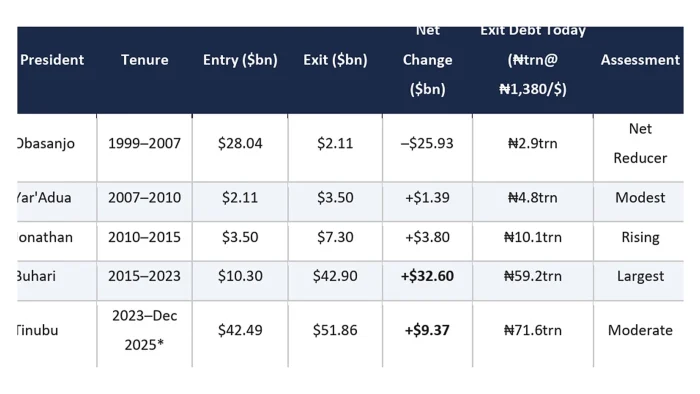
According to The Guardian, Nigeria’s external debt stood at about $42.5 billion in May 2023 and rose to $51.9 billion by December 2025 under Tinubu, representing an increase of roughly $9.4 billion.
By contrast, external debt reportedly grew from $10.3 billion in 2015 to $42.9 billion in 2023 under the Buhari administration, an increase of about $32.6 billion, suggesting a larger expansion in that period.
Analysts argue that recent headline figures have been distorted by exchange-rate reforms introduced in June 2023, which significantly devalued the naira and increased the local currency value of existing foreign debts without equivalent new borrowing.
“The majority of the criticism surrounding Tinubu’s borrowing record has been focused on external debt,” the analysis noted, adding that dollar-denominated comparisons give a clearer picture of actual borrowing.
It further explained that Nigeria’s $42.5 billion inherited debt was equivalent to about ₦19.6 trillion before revaluation but appeared much larger in naira terms after exchange-rate unification.
The report also noted that domestic debt in dollar terms declined from $65.6 billion in Q1 2023 to $59.1 billion by end-2025, partially offsetting external increases.
Overall, total public debt in dollar terms rose only marginally by about $2.7 billion between Q1 2023 and Q4 2025, despite a sharp rise in naira-denominated figures.
NEWS NOW: