
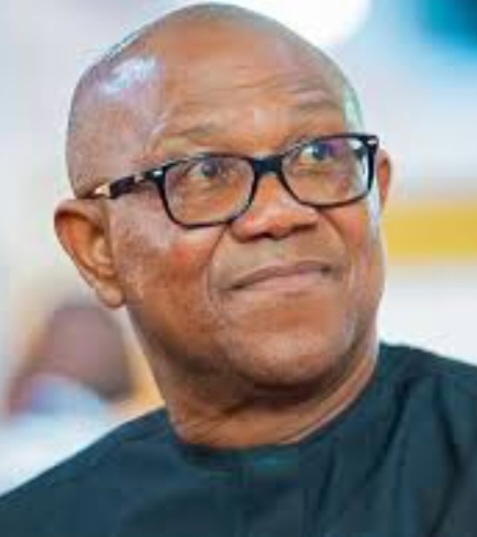
By Onochie Anibeze
What was intended to be a brief exchange at the airport lasted over thirty minutes as we discussed major issues dominating Nigeria’s politics. Despite waiting to board his flight, Peter Obi answered every question without appearing rushed.I began with security, an issue that weighs heavily on Nigerians. I asked what his immediate priorities would be if elected president. He responded that the primary responsibility of any government is the protection of lives and property. He stressed that insecurity cannot be solved by military force alone but requires improved intelligence, better coordination among security agencies, modern technology, proper welfare for security personnel, and a deliberate effort to address poverty, unemployment, and hopelessness, which often create conditions for criminality.
The conversation moved naturally to the economy. On the government’s reforms, Obi acknowledged that reforms are necessary but insisted that they must be carefully planned and compassionately implemented. Nigeria, he argued, must move from consumption to production by investing in agriculture, manufacturing, and small businesses.
When I mentioned the criticism that his proposals often sound attractive but lack sufficient detail, he smiled and said his economic philosophy remained straightforward: reduce the cost of governance, eliminate waste, block leakages, encourage production, and create an environment where businesses can thrive.
To illustrate his point, he compared Nigeria with Bangladesh. Despite having a land mass of only about one-sixth that of Nigeria and a much higher population density, Bangladesh produces roughly ten times more rice than Nigeria. He noted that Northern Nigeria is endowed with vast expanses of fertile land and has the potential to become the food basket of Africa.
“If we secure the North, invest in modern agriculture, expand irrigation, improve rural infrastructure, and guarantee farmers access to finance and markets,” he said, “there is no reason Northern Nigeria cannot become the food basket of Africa.”
He added that agriculture should no longer be viewed merely as a subsistence activity but as an export-driven sector capable of generating more foreign exchange than crude oil.“Oil is a diminishing asset,” he said, “but productive land, properly managed, can create wealth for generations.”On the 2027 elections and political realignments which has exposed his inability to remain in one party and build it, Obi argued that political parties are only vehicles for governance. What matters, he said, is bringing together competent and patriotic Nigerians committed to solving the country’s problems.
I also asked about the persistent speculation that he would serve only one term if elected president in the interest of equity, national unity, and power rotation.
Obi’s response was firm.
“Yes, you can do a lot in four years. You can change Nigeria in four years. I am committed to serving a single term of four years,” he said. “Nigeria’s greatest deficit today is the erosion of trust. We must rebuild confidence by showing that a leader’s word matters.
“An agreement to that effect has already been reached, and I stand by it. If necessary, I am prepared to sign further undertakings, including a legally binding affidavit before a competent court affirming my commitment to one term.“This is bigger than Peter Obi. It is about national healing and unity. It would be a betrayal of trust to seek the support of Nigerians based on such an understanding and later renege on it. Throughout my business career and public life, I have honoured agreements, and I cannot abandon that principle now.
“My objective is not to remain in office indefinitely but to restore security, production, stability, and shared prosperity within the period entrusted to me.”
On whether he was worried about the attacks, criticisms, and pressures directed at him, Obi said that anyone seeking meaningful change must expect resistance.
“Leadership is not about avoiding criticism. When you challenge a system, there will always be opposition. What matters is remaining focused, truthful, and committed to the people. I am not driven by personal ambition but by the desire to see Nigeria work.”
READ THE FULL ARTICLE IN VANGUARD
NEWS NOW: