
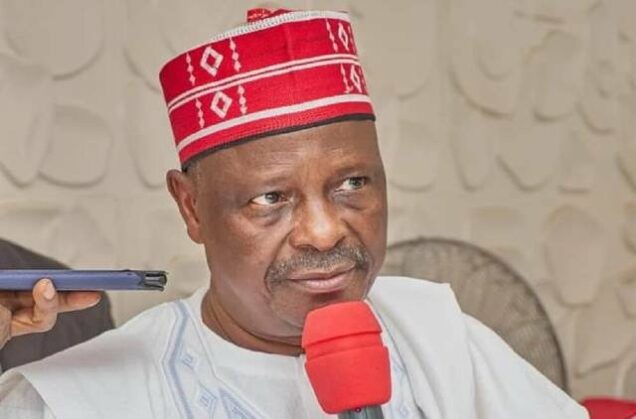
The United States has recommended sanctions against former Nigerian governor Rabiu Kwankwaso over his 2000 proclamation of sharia law in Kano State that applied to non-Muslims, though many Nigerians argue the move is politically motivated retaliation for his criticism of Trump and unfairly targets a politician known for his reluctance to fully implement Islamic law.
By Nij Martin,
The decision by U.S. Congressmen Riley Moore and Chris Smith to recommend targeted sanctions, asset freezes, and visa bans against former Nigerian presidential candidate Rabiu Musa Kwankwaso has sparked fierce debate across Nigeria’s political landscape. At the heart of the controversy lies a single pivotal moment from June 21, 2000, when Kwankwaso, then Governor of Kano State, made a decision that would echo through the decades.
According to Reuters reporting from that day, Kwankwaso proclaimed the adoption of Islamic sharia law in Kano, Nigeria’s most populous northern state, before tens of thousands of jubilant Muslims who chanted “Allahu Akbar” at a ceremony ringed by paramilitary troops and armoured vehicles. The proclamation itself was not unprecedented, as Zamfara State had already adopted sharia. What drew American attention, however, was a critical reversal. After initially stating that a predominantly non-Muslim area would be exempted from sharia law, Kwankwaso withdrew that statement, declaring there would be no exemptions. This meant Islamic law, including severe penalties for blasphemy and other religious offenses, would apply to Christians and other non-Muslims living in Kano State.
This imposition of religious law on non-Muslims is what American legislators have flagged as religious persecution, the primary justification for placing Kwankwaso on a terrorism watchlist alongside entities like the Miyetti Allah Cattle Breeders Association and what they describe as Fulani ethnic militias. The Congressmen cited “a lack of prosecutions of jihadist actors, characterising it as a failure of the Nigerian government,” suggesting a broader pattern of enabling extremism through legal frameworks like sharia.
The American position appears straightforward: by extending sharia jurisdiction over non-Muslims in 2000, Kwankwaso facilitated religious persecution and created legal infrastructure that could be exploited by extremist elements. Some observers note that his action emboldened similar implementations across Nigeria’s core northern states, fundamentally altering the religious landscape of the region.
Yet the Nigerian response has been one of bewilderment and outrage, with many arguing that the Americans have targeted precisely the wrong person. Buba Galadima, a chieftain of the New Nigeria Peoples Party, mounted a passionate defense: “The allegation that Sen. Rabiu Kwankwaso was a financier of terrorism because, according to the U.S., he promulgated Sharia law in Kano that made blasphemy a capital offence, is unfair to him and to his integrity as a peaceful Nigerian. Kwankwaso was the victim of sharia during his time as Governor of Kano.”
Galadima’s argument centers on a crucial historical irony: Kwankwaso’s political career suffered precisely because his sharia implementation was considered inadequate by religious conservatives. He argued: “Kwankwaso did not implement Sharia according to the dictates of Sharia that is how Ibrahim Shekarau became Governor of Kano. How can anybody accuse Kwankwaso, who lost during the battle over Sharia? What about those who started it? This is just politics being played by people who fear Kwankwaso being running for president or vice president of Nigeria, so they have to eliminate him.”
Journalist Jaafar Jaafar reinforced this narrative, writing: “Kwankwaso’s ONLY crime against the Republicans is his patriotic condemnation of Trump’s threats to attack his country. If you are looking for the opposite of a religious extremist, Kwankwaso is one. Kwankwaso lost election in 2003 because of his reluctance to implement Sharia in Kano. His implementation was seen as hapharzard by the fanatics, who promoted Mallam Ibrahim Shekarau’s candidacy.” When Shekarau defeated Kwankwaso, he re-implemented sharia more comprehensively, recruiting thousands of Hisbah personnel for its full enforcement.
Social commentator JJ Omojuwa captured the growing sentiment among many Nigerians: “Irrespective of one’s politics, there won’t be a better time to stand with Senator Rabiu Kwankwaso. I wouldn’t consider myself a full human being with all the dignity and agency God has given each one of us, if just on account of certain prospective repercussions, I will watch a man like him be unfairly targeted, just because he took a stand for his county. Especially when such a stand was in no way a threat to another country. There is absolutely no reason for his name to appear in that document.”
The fundamental question remains unresolved: Is the American action a principled stand against religious persecution based on Kwankwaso’s 2000 decision to apply sharia to non-Muslims, or is it political retribution dressed in counterterrorism language? The timing, coming as Nigeria prepares for its 2027 elections and after Kwankwaso’s public criticism of President Trump, has only deepened suspicions that this controversy has less to do with events from nearly a quarter-century ago and more to do with contemporary political calculations on both sides of the Atlantic.
NEWS NOW: