
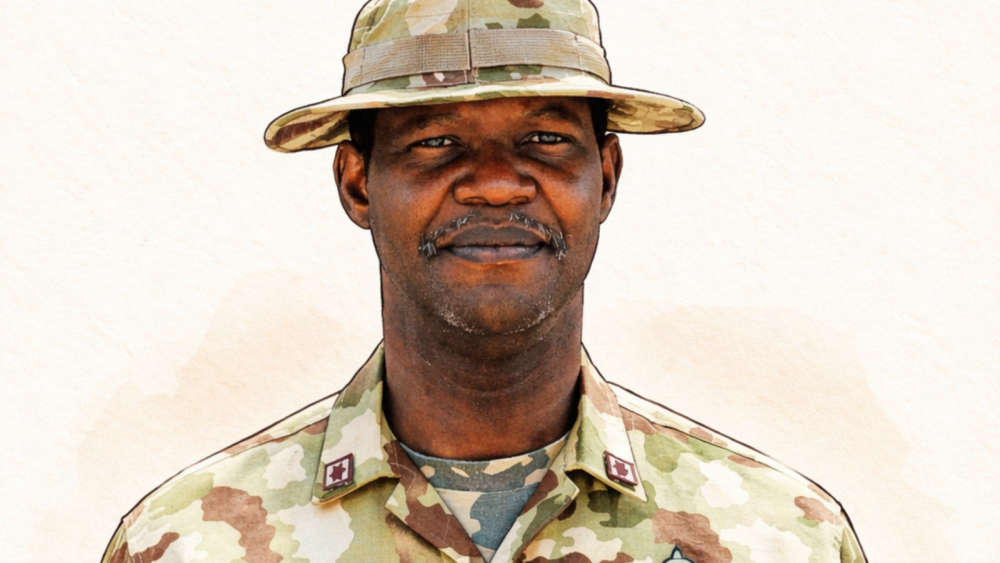
Brigadier General Oseni Braimah was killed when Boko Haram overran his base in Benisheikh, Borno State — but as survivors tell it, he might have escaped if not for a vehicle that would not start, leaving Nigeria to mourn a general whose death has become a symbol of systemic neglect on the front lines.
BENISHEIKH, Nigeria — He was the man in charge. That is always the first thing to understand about Brigadier General O. O. Braimah. When the midnight assault came — coordinated, overwhelming, almost certainly rehearsed for weeks — he did not radio for someone else to handle it. He mounted his Mine-Resistant Ambush Protected vehicle and drove toward the gunfire.
They say the fighting lasted ninety minutes. An eternity when each second sounds like this: boom, crack, scream, silence, repeat.
“We are used to coordinated attacks, but this was different,” a surviving soldier told Saturday PUNCH, asking not to be named. “They came in large numbers from different directions at the same time. It felt like they had studied our positions for weeks.”
Another survivor put it more bluntly: “We stood our ground at first, but they were too many.”
And then the rumor spread through the smoke: the Brigade Commander was dead.
That was when, as one soldier put it, “fear fully set in.”
The Vehicle That Wouldn’t Move
Here is where the story splits into two versions.
Version one — official, sanitized, the kind that fits in a press release:
The Defence Headquarters insists the attack was repelled. Insists troops showed “exceptional courage, professionalism, and superior firepower.” Insists the commander’s MRAP was “temporarily immobilised in the heat of combat while he was actively coordinating the counter-assault.” Not a failure. Just the fog of war.
Casualties? Two officers. Two soldiers. No brigade commander named.
Version two — whispered, raw, the kind soldiers tell each other when no reporter is listening:
“If you talk about maintenance, General Braimah doesn’t play with repairs,” said a former driver who identified himself only as Blacky. “Ask anyone under the 29 Task Force.”
Blacky had driven Braimah for four and a half years. He described a commander who noticed when a driver had been on the front too long, who personally pushed for his rotation. “If you met him with a complaint about money, pass, or anything, he would listen.”
But other sources pointed to a darker pattern: a culture of poor maintenance across the unit. Vehicles that wouldn’t start. Fuel not provided for emergencies. A system where superiors “only advise them to manage it like that.”
One Sahara Reporters source put it in stark terms: Brigadier General Oseni Braimah could have escaped. But the vehicle did not start. They pulled him out. And they killed him.
What the Army Won’t Say
The military’s statement is a masterclass in what we might call careful omission.
“Regrettably, the encounter resulted in the loss of a few brave and gallant soldiers who paid the supreme price in the line of duty.”
A few. Brave. Gallant. Supreme price. These are the words you use when you cannot bring yourself to say: a brigadier general is dead because his vehicle failed him.
Lt. Col. Sani Uba, the media information officer for Operation Hadin Kai, went further on Friday, dismissing viral reports as “false, misleading and exaggerated.” He said only four personnel died. He denied the vehicle was unserviceable.
But he did not explain why, if the attack was successfully repelled, insurgents reportedly operated for hours, set military equipment ablaze, and sent soldiers fleeing into the town for cover.
A resident named Mustapha Abu described the scene:
“We heard loud explosions and continuous gunshots. It was terrifying. People were running in all directions. Even soldiers ran into the town for cover.”
Another resident, who asked not to be named, said: “When I got to the camp after the attack, it was devastating. Vehicles were burned, buildings destroyed. Even civilian shops were not spared.”
The Pattern No One Wants to Name
Brigadier General Braimah is not the first.
Brigadier General Musa Uba — killed in 2025.
Brigadier General Dzarma Zirkusu — ambushed by ISWAP in November 2021.
Colonel Dahiru Chiroma Bako — ambushed in September 2020.
Lieutenant Colonel Muhammad Abu Ali — killed in November 2016.
Lieutenant Colonel Ibrahim Sakaba — killed in November 2018.
Each name is a marble in a bag that grows heavier every year. Each death followed a similar script: coordinated attack, overwhelmed troops, a commander who stayed when others might have run.
Security analyst Brant Philip called Braimah’s death “one of the most significant losses for Nigerian forces in recent months.” He is right. But significance is not the same as surprise.
The question no one wants to ask out loud is this: how many more generals have to die before the vehicles start?
What the Insurgents Know
Here is the cruelest detail.
The attackers did not need to know Braimah’s name. They did not need to know his rank. They only needed to know what every soldier on the front already knows: that the system is brittle. That maintenance is an afterthought. That fuel is never quite where it should be. That a commander can do everything right — can fight for ninety minutes, can coordinate a counter-assault from a burning MRAP — and still lose because the machine would not turn over.
ISWAP has not yet released its weekly report. When it does, analysts expect photos. More details. Perhaps video.
And somewhere in that propaganda, there will be a lesson that the Nigerian military cannot afford to learn again: the enemy is studying your weaknesses in real time.
The President’s Consolation
President Bola Tinubu issued a statement Thursday night, conveyed by his special adviser on information and strategy, Bayo Onanuga.
“From the reports I have received, our armed forces have been conducting sustained and intense land and air offensives against insurgents, neutralising many of their fighters and commanders. The insurgents’ counterattack is a sign of desperation.”
Desperation. That is one word for it.
Another word is intelligence. Another is coordination. Another is exploitation of known vulnerabilities.
Tinubu urged the military not to be discouraged. He said the fallen soldiers would be honored. He said the government remained committed to defeating terrorism.
None of that starts a dead general’s vehicle.
None of that explains why a brigade commander — a man described by his own driver as meticulous about repairs — ended his life pulled from an MRAP that would not move.
The Thing Nobody Says Out Loud
Here it is.
Braimah could have run. Nobody would have blamed him — not really, not in the moment, not when the insurgents came from every direction and the radios went hot with reports of other positions falling. He was the commander. Commanders are allowed to retreat to a safer position and direct the fight from there.
He did not run.
He got in the vehicle. He drove toward the gunfire. And when the vehicle stopped moving, he did not stop fighting.
That is the part the official statements cannot capture. That is the part that will never fit in a press release about “exceptional courage.”
A former frontline driver named Blacky described the general he knew:
“If you met him with a complaint about money, pass, or anything, he would listen. I am not covering him because I was his former driver. What I am saying is fact.”
Fact: a brigadier general is dead.
Fact: the vehicle did not start.
Fact: the system that was supposed to support him — maintenance, fuel, operational readiness — appears to have failed at the exact moment he needed it most.
And fact: when the next attack comes — and it will come — there will be another commander in another MRAP, praying that this time, the engine turns over.
What do you believe killed Brigadier General Braimah? Combat? Or complacency?
Additional reporting by Saturday PUNCH, Sahara Reporters, and Anadolu. Quotes preserved as originally published.
NEWS NOW:
- Finally, Taiwo Oyedele admits to manual errors in Nigeria’s new tax laws
- We have executed visa bans on religious freedom violators in Nigeria, says US principal adviser
- Nigerian migrant who failed UK driving tests jailed after killing pensioner in car crash
- ‘Not welcome in America’– U.S. implements visa bans for Nigerian religious freedom violators