
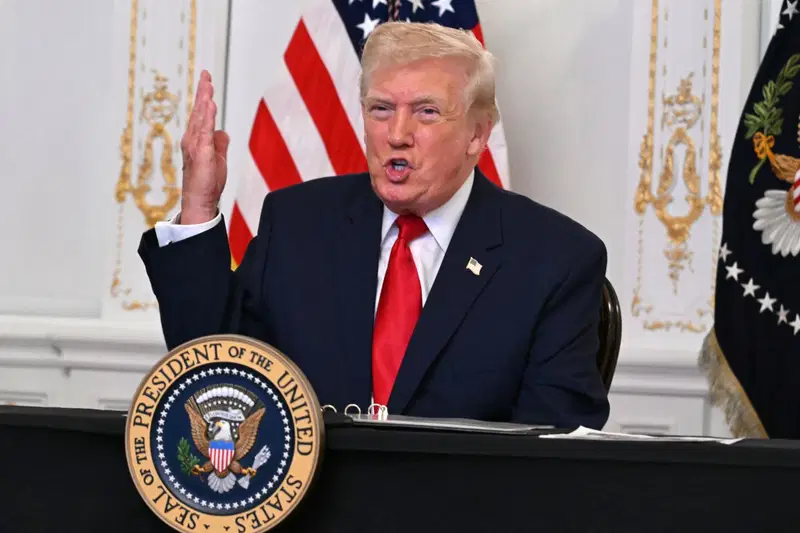
President Donald Trump has suspended a planned military strike on Iran for two weeks following last-minute mediation by Pakistan, with Tehran agreeing to a conditional reopening of the strategic Strait of Hormuz.
United States President Donald Trump has agreed to a 14-day suspension of planned military strikes against Iran, narrowly avoiding a massive escalation just 88 minutes before a self-imposed deadline. Taking to Truth Social at 6:32 p.m. Eastern Time on Tuesday, the President announced he had reversed course on his threat that “a whole civilization will die tonight” following intensive mediation by Pakistani leadership. Trump confirmed the reprieve is strictly contingent upon the Islamic Republic facilitating the unhindered movement of global trade through one of the world’s most vital energy arteries. “Based on conversations with Prime Minister Shehbaz Sharif and Field Marshal Asim Munir, of Pakistan, and wherein they requested that I hold off the destructive force being sent tonight to Iran, and subject to the Islamic Republic of Iran agreeing to the COMPLETE, IMMEDIATE, and SAFE OPENING of the Strait of Hormuz, I agree to suspend the bombing and attack of Iran for a period of two weeks,” Trump wrote.
The breakthrough was quickly acknowledged by Tehran, signaling a rare, if fragile, diplomatic opening after five weeks of open hostilities. Iranian Minister of Foreign Affairs Abbas Araghchi confirmed that the Islamic Republic would reciprocate the de-escalation by ceasing its “defensive operations” and coordinating transit through the strategic waterway. “If attacks against Iran are halted, our Powerful Armed Forces will cease their defensive operations,” Araghchi wrote in a public statement. He further clarified that “for a period of two weeks, safe passage through the Strait of Hormuz will be possible via coordination with Iran’s Armed Forces and with due consideration of technical limitations.” Araghchi joined the U.S. President in expressing gratitude to Pakistan for its last-minute intervention to halt the American bombing campaign.
While the immediate threat of a “stone age” bombardment has subsided, the two-week window represents a high-stakes probationary period for regional security. Iran’s Supreme National Security Council hinted in a separate communiqué that the temporary ceasefire could be extended into a more permanent settlement if subsequent negotiations regarding the broader conflict proceed favorably. However, the U.S. administration has made it clear that the “destructive force” remains on standby should the reopening of the Strait of Hormuz face any technical or military interference. As global oil markets react to the reprieve, diplomats in Islamabad and Muscat are reportedly preparing for a marathon round of talks aimed at transforming this 14-day pause into a lasting diplomatic resolution.
READ THE FULL STORY IN AL JAZEERA
NEWS NOW:
- ‘I pay obeisance to my Ifa when I wake, use juju for my progress’ – Saheed Osupa reveals
- ‘Remove Burna Boy from playlists’ –DJs ban singer’s songs over clash with DJ Tunez
- Outrage as bandits kill Abuja trader , UniAbuja daughter after ₦12m ransom payment
- ADC crisis deepens as Kachikwu loyalists form third faction, appoint interim chair