
by Nij Martin
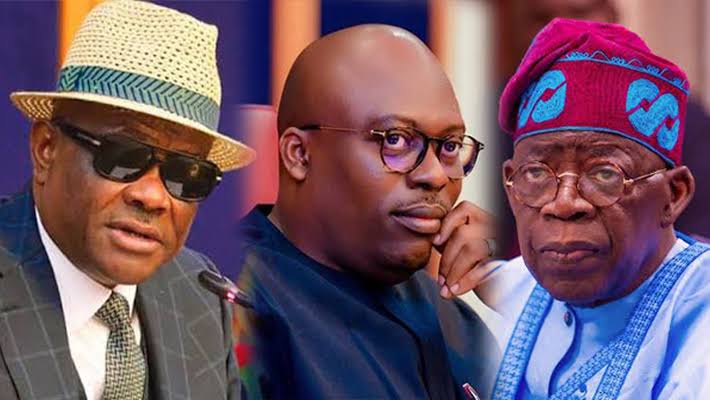
The political crisis consuming Rivers State has become a grotesque spectacle of personal vendetta masquerading as governance, and at its center stands a troubling question: Is President Bola Tinubu genuinely helpless against his own minister, or is he complicit in the chaos?
For the second time in barely a year, the Rivers State House of Assembly has initiated impeachment proceedings against Governor Siminalayi Fubara and his deputy, Ngozi Odu. The charges—demolition of the Assembly Complex, extra-budgetary spending, withholding Assembly funds, and defying Supreme Court rulings—mirror almost exactly the allegations that preceded the declaration of emergency rule and Fubara’s six-month suspension in March 2025. The pattern is unmistakable: this is not about governance failures but about one man’s obsessive determination to maintain control over a state he no longer governs.
That man is Nyesom Wike, the FCT Minister who has transformed from political godfather into what critics now call a “monster” that even the President cannot—or will not—tame.
The Anatomy of a Never-Ending Crisis
The Rivers conflict did not emerge from ideological differences or policy disputes. It stemmed from something far more primal in Nigerian politics: a broken succession pact. Wike engineered Fubara’s emergence as governor in 2023, apparently expecting a pliant successor who would allow him to continue controlling Rivers State from his Abuja perch. What he got instead was a governor who discovered that power, once transferred, refuses to remain remotely controlled.
The fallout has been systematic and devastating. Governance has stalled. Institutions have buckled. The Peoples Democratic Party in Rivers fractured into warring camps. Eventually, Fubara defected to the All Progressives Congress, presenting the move as political survival. But the defection brought no peace—it merely widened the battlefield, transforming a PDP internal squabble into an APC national crisis.
Now, uneasy calm reigns in Port Harcourt. Residents go about their business while anxiety hangs heavy in the air. Stakeholders mount pressure on lawmakers to halt the impeachment, with Fubara reportedly out of the country and yet to be served with the impeachment notice. Meanwhile, the minister who should be focused on developing the Federal Capital Territory has instead spent over a week touring Rivers State local governments, openly insulting and threatening a sitting APC governor.
Wike Unbound: The Minister Who Answers to No One
What makes this crisis particularly disturbing is Wike’s brazen defiance of every norm of political decorum and party hierarchy. He is not even an APC member, yet he has warned the party’s National Secretary, Senator Ajibola Basiru, to “leave Rivers State alone.” When Basiru reiterated that sitting governors remain party leaders in their states—a fundamental APC doctrine—Wike responded with threats and allegations that Basiru and other APC leaders might have received illegal benefits from Fubara.
More shockingly, Wike has essentially placed himself above President Tinubu. In a recent address, the minister boasted: “I hear that people are boasting that they will call me and give me instructions. Let me tell you, there’s nothing like instruction as far as Rivers State is concerned. Nobody will call me. We have agreed Mr President will serve his two terms, but the other one is a no-go area. I challenged the Federal govt when I was governor…I will challenge them again…”
Read that again slowly. A sitting minister is warning the President of Nigeria—his boss, the national leader of the APC—never to meddle in Rivers State affairs, or he will “challenge” him. If this is not effrontery, insolence, and impertinence of the highest order, what is?
Professor Abubakar Kari of the University of Abuja was blunt in his assessment: “It is also becoming very clear that Wike has become an embarrassment. Because he’s elevating personal feud to statecraft. He has this feeling; I don’t know where he got the idea from that he’s untouchable… that he’s too close to the president that he can do anything and get away with it.”
The APC’s Impossible Arithmetic
The crisis presents the APC with a calculation that defies easy resolution. The party’s national leadership initially sent warm signals to Fubara after his defection. The National Secretary led a delegation to Port Harcourt and publicly endorsed him for a second term. The National Chairman declared Fubara the leader of the party in Rivers State. An APC chieftain revealed that the party had reached consensus to grant automatic return tickets to governors who defected from other parties—Fubara was explicitly in that category.
Yet Wike rejected these declarations outright, reaffirming an enduring truth of Nigerian politics: party titles and endorsements do not automatically translate into political control when raw power and wealth are in play.
The arithmetic confronting the APC is stark. If Fubara secures the party’s governorship ticket, he enters the 2027 race as an incumbent with access to state machinery and resources. The campaign largely funds itself, and the party benefits from unity—however uneasy. If he is denied the ticket, the APC must bankroll Rivers from Abuja, fighting a sitting governor who remains the recognized leader of the party in the state. Such a move risks alienating Fubara’s supporters, dampening enthusiasm for President Tinubu, and opening space for protest votes.
As Professor Kari observed: “Perhaps the major reason APC will not likely sacrifice Mr Fubara is that he has the capacity to do exactly what Wike can do for (President) Tinubu: to mobilise support for him. It does not pay the APC or Mr Tinubu to sacrifice Governor Fubara because of Wike. Politics is a practical thing.”
The Tinubu Question: Helpless or Complicit?
This brings us to the central question that haunts this entire saga: Where is President Tinubu in all of this?
Reports indicate that Tinubu has summoned Wike for a meeting outside Nigeria, with sources suggesting Dubai as the likely venue. Fubara reportedly flew out on a private jet Thursday, possibly to meet the President in France. These clandestine arrangements speak volumes about the delicacy—or dysfunction—of the situation.
A highly placed source close to the President was emphatic: “What is happening is outright disrespect to the President by Wike, and it is against national interest. One of the reasons a state of emergency was declared in Rivers in March last year was the fear of a breakdown of law and order and the attendant consequences for oil production. If you say you want to sack the first Ijaw man to be governor, are you not sending the Ijaw people back to the creeks? That will have attendant effects on the economy, and the President will not allow that to happen.”
Yet the President’s silence has been deafening. The APC Governors Forum has not uttered a word to condemn Wike or support Fubara. This silence suggests either presidential helplessness or complicity—neither interpretation reflects well on Nigeria’s leadership.
Development consultant Jide Ojo argues that the power Wike wields flows directly from the presidency: “All the powers and influence Mr Wike enjoys today come from the presidency. He (Tinubu) has the yam; he has the knife.” Ojo believes Tinubu can broker a settlement but notes Wike’s genuine fear: “Wike expressed fears that if Fubara wins a second term, he (Wike) will be buried alive politically, and that is a genuine fear. Every politician wants to remain relevant.”
The prevailing theory is that Tinubu remains convinced that without Wike, his chances of winning the 2023 election would have been far slimmer or even zero. This gratitude has apparently created an untouchable monster. As one analyst put it: “The Wike-Tinubu love affair and its noxious impacts on our polity are a good example of why good character is an essential ingredient in leadership. Both men love, admire and inspire each other so much so that they will do anything for each other, even at a huge cost to the nation.”
Who Blinks First?
Multiple stakeholders have waded into the crisis. The Pan-Niger Delta Elders Forum (PANDEF) condemned the impeachment process and established a seven-member reconciliation committee chaired by former Attorney-General Chief Kanu Agabi, SAN. Chief Anabs Sara-Igbe called on President Tinubu to “save the state from unnecessary tension,” warning that “if President Tinubu desires victory in Rivers state in 2027 and the Niger Delta as a whole, he should call Wike to order.”
The International Society for Social Justice and Human Rights warned lawmakers “not to take the patience of Rivers people as weakness,” while former Ekiti Governor Ayo Fayose ominously declared that “only prayers and fasting” could save Fubara from impeachment, adding: “Ingratitude and being ungrateful will create so much headache for anyone.”
Yet the fundamental question remains: In this high-stakes game of political chicken, who blinks first?
Fubara has shown unexpected resilience, surviving one impeachment attempt and six months of suspension only to emerge politically stronger through his APC defection. He now controls state resources and enjoys backing from influential APC power brokers, including governors who see Wike’s approach as destabilizing. The APC’s institutional machinery has aligned behind him, with clear statements from party leadership affirming his position.
Wike, meanwhile, has wealth, ruthlessness, and apparent presidential protection. He’s touring all 23 local governments, rallying supporters, and has warned that Fubara’s re-election would “kill him politically.” He’s even positioning his 25-year-old son for a House of Representatives seat in 2027, signaling his intention to establish a political dynasty.
The Larger Stakes
Beyond the personal drama, this crisis tests whether party rules will prevail over personal power, whether incumbency still confers protection, and whether Nigeria’s ruling party is governed by institutions or by strongmen.
Former Senator and APC chieftain Ita Enang was categorical: “The governor of a state, by an APC unwritten statement, is the leader of the party in the state. The APC national leadership has an understanding that governors of other political parties who defected to the party will be given the right of first refusal on a second-term ticket and the right to control the party structure at the state level.” He added bluntly: “Wike is a factional leader of the PDP at the national level, and there is no way Wike can determine who gets a ticket under the APC platform in Rivers.”
An APC National Working Committee member, speaking anonymously, urged Tinubu to recognize the dangers: “For a minister to instigate actions likely to lead to insecurity and a breakdown of law and order shows a lack of regard for the President and national interest, or a preference for personal ambition. Stakeholders believe Wike has become an albatross for the President, and they are watching closely to see what step the President will take—whether he will allow Wike to continue riding roughshod over everyone.”
The crisis has already cost Rivers State dearly. Two years of political warfare have paralyzed governance, tarnished the state’s image, and created an environment of perpetual instability. As former Senator Andrew Uchendu observed: “Mr President should step in and call the parties to order.”
Final Thoughts: A Test of Presidential Authority
The never-ending Rivers crisis is ultimately a referendum on President Tinubu’s authority and judgment. Can he control his own minister? Will he enforce party rules and protect a sitting APC governor? Or will gratitude for past political favors blind him to the damage being inflicted on Nigeria’s democratic institutions?
If Tinubu blinks and sacrifices Fubara to appease Wike, he signals that proximity to power matters more than party membership, that personal loyalty trumps institutional rules, and that ministers can operate above presidents. If he stands firm with Fubara, he reaffirms that the APC is governed by principles, not personalities, and that even political debts have limits.
The choice before Nigeria’s President is clear. The consequences of that choice will reverberate far beyond Rivers State, defining whether this administration is remembered for strengthening democratic institutions or for enabling their capture by unaccountable strongmen.
In Rivers State, everyone is watching, waiting to see who blinks first. The answer will tell us everything we need to know about who truly governs Nigeria.