
by Nij Martin
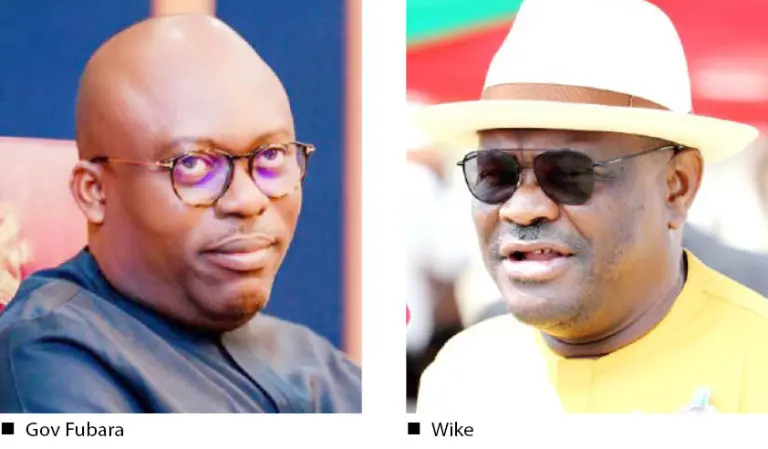
In the unforgiving arena of Nigerian politics, few spectacles are as dramatic as watching a seemingly invincible godfather brought to his knees by the very protégé he installed in power. Nyesom Wike, long regarded as one of Nigeria’s most ruthless and calculating political operators, now finds himself in an unprecedented predicament: outmaneuvered, isolated, and increasingly irrelevant in the very state he once controlled with an iron fist. The architect of his downfall? Governor Siminalayi Fubara, the quiet loyalist who proved to be a master strategist capable of systematically dismantling his godfather’s political empire with calculated precision.
The Godfather’s Grand Design
To understand the magnitude of Fubara’s checkmate, one must first appreciate the dominance Wike exercised over Rivers State politics. As governor from 2015 to 2023, Wike transformed Rivers into his personal fiefdom, crushing opponents, manipulating party structures, and accumulating political capital that made him indispensable to any presidential aspirant seeking relevance in the South-South region.
His 2023 defection from supporting the PDP’s presidential candidate to backing Bola Tinubu was classic Wike: audacious, transactional, and devastatingly effective. That gambit delivered crucial votes to the APC and earned Wike the coveted FCT ministerial position. More importantly, it secured what he believed was a permanent seat at the table of power.
When selecting his successor, Wike chose Fubara carefully. The former accountant general was perceived as loyal, unambitious, and dependent—the perfect puppet governor who would allow Wike to continue pulling strings from Abuja while maintaining control over Rivers State’s substantial resources. It was a calculation that countless Nigerian godfathers had made before him. Like those predecessors, Wike would learn that underestimating one’s successor is a fatal political error.
The Quiet Revolutionary
Governor Fubara’s political genius lies in his deceptive simplicity. While Wike issued threats and engaged in theatrical displays of power, Fubara played a longer, more sophisticated game. He understood what Wike apparently did not: that in politics, institutional legitimacy ultimately trumps personal intimidation.
The emergency rule declared by President Tinubu in March 2025, which suspended Fubara for six months, could have broken a weaker politician. Instead, Fubara used those months to consolidate support, build alliances, and plan his masterstroke. When he returned to office in September after the second peace deal brokered by Tinubu, he wasn’t the same compliant figure Wike had installed.
Fubara’s defection to the APC was nothing short of brilliant political maneuvering. By joining the ruling party, he accomplished several objectives simultaneously: he positioned himself as the legitimate party leader in Rivers State by constitutional convention, he aligned himself with President Tinubu’s interests, and most devastatingly, he exposed Wike’s fundamental weakness—the former governor wielded ministerial power but lacked formal party membership in the APC.
This single move transformed the entire political landscape. Suddenly, Wike was the outsider looking in, a PDP exile serving in an APC government while trying to control a state now led by an APC governor. Fubara had turned his godfather’s supposed strength—his ability to operate across party lines—into his greatest vulnerability.
The Unraveling of Wike’s Authority
The public confrontation between Wike and APC National Secretary Ajibola Basiru reveals just how completely Fubara’s strategy has worked. When Basiru declared support for Fubara as the rightful APC leader in Rivers State, Wike responded with characteristic bluster, warning the APC scribe to “leave Rivers State alone” and threatening that those who interfere would “burn their hands.”
But Basiru’s response exposed the emperor’s nakedness. His blunt assertion that Wike “is not a member of our party” and “lacks the locus to dabble into the affairs of our party” wasn’t just a rebuke—it was a political death sentence. Coming from the APC’s chief administrative officer, this statement effectively stripped Wike of any claim to legitimacy in Rivers State politics.
What makes this particularly devastating is that Basiru was defending Fubara. The APC’s institutional machinery had aligned behind the governor, leaving Wike politically orphaned. His threats rang hollow because everyone now understood what Fubara had orchestrated: Wike had no institutional base from which to threaten anyone.
Wike’s increasingly desperate rhetoric confirms his diminished status. His allegations that politicians are flocking to Rivers State “because you have heard that we have N600bn” sound less like the pronouncements of a kingmaker and more like the paranoid ramblings of someone who has lost control of the narrative. His warning that “the mistake we made in 2023 will not be repeated” in 2027 is particularly telling—what organizational structure will he use to make good on this threat? What party machinery can he deploy? The answers expose his impotence.
The Strategic Depth of Fubara’s Victory
Fubara’s checkmate extends beyond mere party politics. He has systematically dismantled every pillar of Wike’s power:
Institutional Legitimacy: By joining the APC and becoming governor, Fubara now holds the two most important cards in Rivers State politics—executive power and party leadership. Wike holds a federal ministerial position that, while prestigious, grants him no authority over state affairs.
Presidential Access: While Wike claims proximity to President Tinubu, Fubara has demonstrated that he too enjoys presidential support. The fact that Tinubu has remained conspicuously silent during Wike’s confrontation with Basiru speaks volumes. The president appears to be hedging his bets, and in Nigerian politics, presidential silence often precedes political abandonment.
Party Protection: The Arewa Progressives Frontiers, a pro-APC group, has publicly questioned Wike’s status, asking “Is Nyesom Wike a member of APC? Why is he crying more than the bereaved?” This isn’t random criticism—it reflects growing sentiment within the APC that Wike has become more trouble than he’s worth. Meanwhile, Fubara enjoys the full backing of APC structures in Rivers State.
Popular Narrative: Perhaps most importantly, Fubara has won the narrative battle. He is increasingly portrayed as the embattled governor standing up to a bullying godfather, while Wike is cast as the aggressor trying to destabilize a sitting governor. In a democracy, this narrative advantage is crucial.
The Godfather’s Fatal Flaws
Wike’s downfall stems from classic godfather syndrome: the belief that personal power supersedes institutional authority. He assumed that his relationship with Tinubu and his control over resources would permanently secure his dominance over Rivers State politics. He failed to account for three critical factors:
First, he underestimated Fubara’s intelligence and ambition. The accountant proved to be a far more sophisticated political operator than anyone, including Wike, anticipated.
Second, he misjudged the APC’s institutional interests. The party has a sitting governor in Rivers State who is delivering stability and party growth. Why would they sacrifice that for a non-member minister who brings constant controversy?
Third, and most fatally, he overplayed his hand. By publicly threatening APC officials, allegedly manipulating federal agencies like the EFCC (as claimed by the Coalition of Northern Groups), and refusing to recognize institutional boundaries, Wike has made himself toxic. Even the PDP, his former party, has explicitly stated he was expelled and that the APC must “manage the situation they have created” by engaging him.
The Endgame
As this political drama unfolds, the trajectory seems clear. Fubara has positioned himself as the future of Rivers State politics, while Wike increasingly resembles a relic clinging to past glories. The governor controls the party machinery, enjoys institutional legitimacy, and has demonstrated the political acumen to outmaneuver Nigeria’s most feared operator.
Wike’s vow that “where we voted in the state is not where we will vote again in 2027” sounds less like a threat and more like an acknowledgment that he has lost his traditional strongholds. His warning to Basiru and other APC leaders betrays desperation—confident politicians don’t need to issue such theatrical threats.
The irony is exquisite: Wike, who built his reputation on his ability to install and control governors, has been defeated by his own creation. Fubara has proven that in modern Nigerian politics, institutional legitimacy and strategic patience can overcome raw power and intimidation.
Final Thoughts: Lessons from a Fallen Godfather
The Wike-Fubara saga offers profound lessons about the evolution of Nigerian politics. The era of the all-powerful godfather who controls states from afar may be ending, replaced by more sophisticated political actors who understand that institutions, when properly leveraged, provide more sustainable power than personal dominance.
Fubara’s checkmate of Wike represents more than a personal victory—it’s a demonstration that political intelligence can triumph over political intimidation, that strategic patience can defeat impulsive aggression, and that the student can indeed surpass the master.
For Nyesom Wike, the fall from godfather to marginalized figure has been swift and brutal. His attempts to maintain relevance through threats and bluster only underscore how completely he has been outmaneuvered. In chess, checkmate means the king has no legal moves remaining. In Rivers State politics, Wike is discovering that Fubara has placed him in precisely that position—powerless, isolated, and unable to escape the trap set by the very man he believed would remain forever under his control.
The godfather has fallen, and his fall teaches us that in politics, as in chess, underestimating your opponent is the surest path to defeat.