
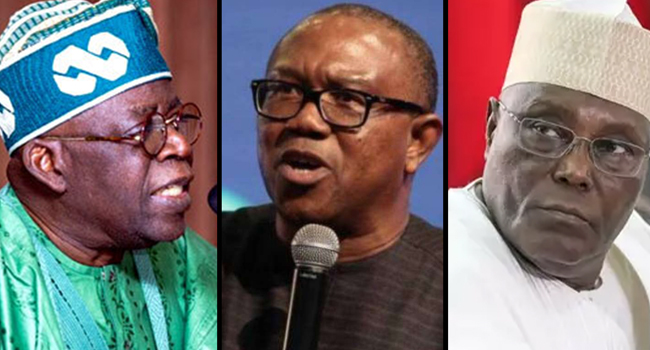
Senior opposition leaders accuse President Tinubu of using state institutions to coercively engineer a one-party state, a charge his administration vehemently denies, framing the conflict as a clash between legitimate accountability and the systematic erosion of multi-party democracy.
by Nij Martin
A seismic political fault line has cracked open in Nigeria, dividing the landscape into two irreconcilable narratives about the very future of the country’s democracy. On one side, a formidable coalition of opposition elders—Atiku Abubakar, Peter Obi, David Mark, and John Oyegun—has levelled a grave charge: that President Bola Tinubu is the chief architect of a “gradual slide” into a one-party state. On the other, the Presidency fires back with equal force, painting the accusers as a “failed opposition” engaging in “subterfuge” to escape accountability. This is more than partisan mudslinging; it is a fundamental disagreement over whether Nigeria is witnessing the natural realignment of a vibrant democracy or the calculated consolidation of power by a ruling party intent on hollowing out its competition. The evidence, motivations, and consequences of this clash reveal why the finger of blame is pointed squarely at Tinubu’s door.
The opposition’s core argument is one of systemic coercion, not voluntary political migration. They contend that Tinubu’s APC is achieving dominance not at the ballot box but through the backdoor, using the state’s coercive apparatus. Their statement alleges “a covert, undemocratic agenda to ensure that all state governments fall under the control of the President’s party… by intimidating opposition governors via the anti-corruption apparatus.” The recent, rapid defection of multiple PDP governors—Fubara of Rivers, Mbah of Enugu, Diri of Bayelsa—is cited not as proof of the APC’s ideological appeal, but of a chilling calculus. As PDP chieftain Niyi Aborisade asserted, Governor Fubara defected out of “fear and lack of protection,” a sentiment framing the ruling party as a refuge from state-sponsored pressure, not a destination for political conviction. This perception turns Tinubu from a mere party leader into a ringmaster of what analyst Chukwuma Okenwa calls a “winner-takes-all” model, where the lines between governing and vanquishing the opposition blur dangerously.
Central to this accusation is the alleged weaponisation of key institutions, particularly the Economic and Financial Crimes Commission (EFCC). The opposition claims the agency has become “an instrument of political persecution,” where “allegations against members of the ruling party are routinely perceived to be overlooked, while even unsubstantiated accusations against opposition figures are vigorously pursued.” This creates a powerful, two-pronged tool for Tinubu: it tarnishes opponents with the brush of corruption (often through media trials) while offering a clandestine bargain—defect, and your “sins” may be forgiven. This recalls the infamous remark by a former APC chairman about forgiving the sins of defectors, a comment the opposition now cites as prophetic. For critics, Tinubu’s fault lies not in fighting corruption, but in allegedly overseeing a selective fight that serendipitously weakens his political adversaries while strengthening his party’s ranks, thereby undermining the very rule of law he is sworn to uphold.
The Presidency’s rebuttal, delivered with dismissive force by Bayo Onanuga, constructs a completely different reality. Here, Tinubu is not an orchestrator but a focused reformer, and the defections are a pure market reaction to good governance. The wave of joiners is attributed to “the noticeable gains of President Bola Tinubu’s reform programme.” The opposition’s alarm is framed as the squealing of elites being held accountable for the first time. “Those who have cases to answer before EFCC should be bold and brave enough to defend themselves if they are clean,” Onanuga states, painting the accusers as hypocrites whose “chickens are coming home to roost.” In this narrative, the EFCC is an independent actor, and Tinubu “does not issue directives on whom to investigate.” The fault, therefore, lies not with the President but with a corrupt, desperate political class weaponising politics to “escape accountability.”
However, this robust defence struggles to fully dispel the pervasive patterns that fuel public suspicion. The timing and targets of high-profile investigations, the sequential defections immediately following political crises (as seen in Rivers State), and the palpable weakening of opposition structures create a circumstantial case that is powerful in the court of public opinion. Even if Tinubu never picks up the phone to direct the EFCC, the perception that the system operates to his party’s advantage is itself a corrosive political weapon. As Prof. Pat Utomi notes, the political class has exposed itself as largely comprised of “rent seekers,” willing to flock to power for survival. Tinubu’s administration, by this view, has simply perfected the environment for this flocking to occur, making him passively complicit in the erosion of a robust multi-party system.
Ultimately, the question of Tinubu’s fault hinges on a distinction between active conspiracy and passive benefit. Is he deliberately dismantling multi-party democracy, or is he merely the beneficiary of a broken political culture and legitimate enforcement actions that happen to benefit his party? The opposition argues the former, citing a deliberate pattern. The Presidency insists on the latter, championing accountability and reform. Yet, in politics, perception is potent reality. The chilling effect on dissent, the erosion of trust in independent institutions, and the spectacle of a vanishing opposition are tangible outcomes that stain the democratic landscape. Whether by design or by the inertia of a system bending to his power, President Tinubu now owns the consequence: a nation where the vibrant, chaotic, and competitive democracy that brought him to power is perceived to be in retreat. His legacy may be defined not just by his economic reforms, but by whether he presides over the consolidation of Nigerian democracy or its quiet contraction. The burden of proof—and the historical judgement—rests with the man at the helm.