
“The decline is as a result of the worsening business environment in the country.”
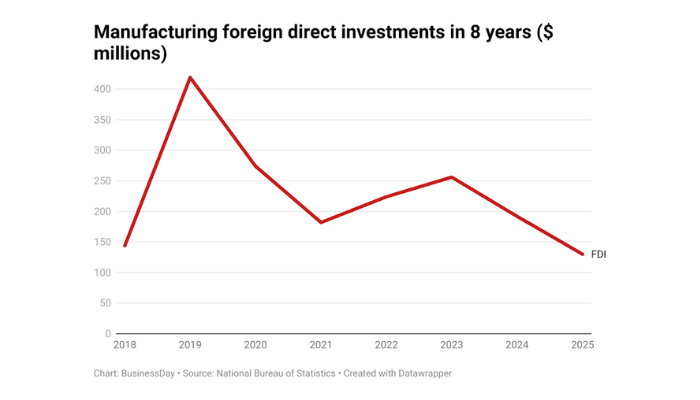
Capital importation into Nigeria’s manufacturing sector has fallen to its lowest point since 2017, according to National Bureau of Statistics (NBS) data. Foreign investments dropped 10 percent from $144.09 million in Q1 2018 to $129.9 million in Q1 2025. Quarter-on-quarter, it plunged 69 percent from $421 million in Q4 2024.
Manufacturers attribute the slump to a worsening business climate. “The decline is as a result of the worsening business environment in the country,” said Frank Ike Onyebu, former chairman of the Manufacturers Association of Nigeria (MAN), Apapa branch.
Onyebu noted that forex stability has brought some respite, but rising operational costs, a new four percent FoB charge, and poor infrastructure continue to stifle growth. Energy costs remain a major burden, with MAN estimating manufacturers spend 40 percent of production costs on power.
Despite improved daily electricity supply in 2024, tariffs surged over 200 percent for Band A consumers, while frequent outages and 12 grid collapses persisted.