
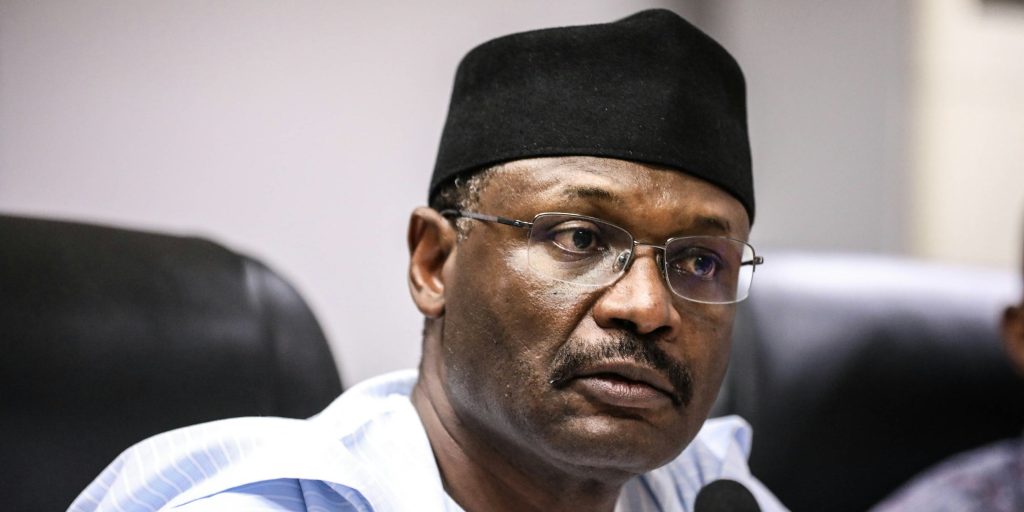
The Nigerian Senate confirmed the appointment of the immediate past chairman of the Independent National Electoral Commission (INEC) as an ambassador in December 2025. This has resurfaced concerns about electoral integrity in the country.
Mahmood Yakubu stepped down as head of the electoral commission just three months prior to the ambassadorial appointment.
As a political scientist with published research on the electoral commission and electoral integrity in Nigeria, I argue that even though the president has a right to make the appointment under Section 171 of the constitution, it is still troubling. There are a number of reasons.
Firstly, it raises questions about institutional neutrality and public trust. It looks like a reward for the way elections were administered.
Yakubu’s tenure as chairman included the controversial 2023 general elections. Questions were raised about the commission’s credibility following logistical failures, technological breakdowns and delayed transmission of results. Though the courts ultimately upheld the declared outcomes, the election’s legitimacy remains hotly debated among citizens, civil society and scholars.
The same electoral umpire has been appointed to a prestigious diplomatic role less than three years after conducting an election that returned the appointing authority to power.
Secondly, it undermines public confidence at a time of rising political disengagement. Nigeria’s democracy is facing a legitimacy challenge driven by civic disillusionment, youth disengagement, and declining trust in institutions. Voter turnout in the 2023 presidential election, roughly 26% of registered voters, was one of the lowest in the country’s democratic history.
Thirdly, it reflects a weakening of institutional checks and legislative oversight. Despite widespread objections, the Senate approved the nomination with minimal dissent. A weak or compliant legislature reduces the institutional safeguards that protect elections from political capture.
Nigeria must strengthen electoral governance. This should include cooling off periods for electoral commission officials, stronger Senate oversight, protected institutional autonomy, and sustained civic re-engagement.
Impartiality and the perception of political reward
Electoral commissions thrive on perceived impartiality as much as on legal independence.
In a region where democratic norms are weakening as seen in Mali, Niger, Burkina Faso, Guinea and others, the perception that electoral officials may receive political rewards, especially if they manipulate the electoral institution to favour a candidate, can further erode trust. It sends a signal, intended or not, that electoral umpires can swiftly take on political roles.
This may influence future behaviour within the electoral commission. It becomes harder to preserve the principle of neutrality.
Ebbing trust in elections
Many Nigerians already believe that the electoral umpire is compromised. A 2023 report revealed that some senior electoral officials were politically affiliated with the ruling party.
A 2023 Afrobarometer report showed that 76% of Nigerians expressed a lack of trust in the commission.
In a recent paper, my colleague and I identified constraints on the commission. These included corruption, lack of adherence to its rules, and lack of independence.
Yakubu’s appointment risks deepening cynicism and feeding narratives of elite collusion.
For a democracy already struggling with fractured trust, where young people question whether voting makes a difference, this symbolic gesture may accelerate disengagement. When citizens lose faith in elections, they may turn to protest or apathy. Worse, they might support anti-democratic alternatives such as military intervention. It’s a trend already visible in Mali, Burkina Faso, Guinea and Niger.
Weakening checks and balances
The Senate’s role in the affair raises equally troubling concerns.
Rather than exercising its constitutional role as a check on executive appointments, the Senate appeared to align seamlessly with the president’s preferences. Most of the nominees were only asked by the Senate to bow and go.
This pattern of legislative passivity, common in Nigeria across all tiers of government, mirrors broader regional trends. Parliaments, whether in Togo, Benin or Senegal, have gradually ceded oversight functions to executives.
When political institutions become less independent, electoral oversight becomes more fragile.
A weak or compliant legislature reduces the institutional safeguards that protect elections from political capture.
The confirmation thus symbolises a gradual erosion of institutional balance. It’s a worrying sign in a region where democratic backsliding is accelerating.
What should be done
Reforms are essential.
In the US and Australia, revolving door laws exist to prevent former senior officials who occupied critical positions of trust from using their positions for political gains. They typically observe a cooling-off period before moving into a role that may risk a conflict of interest.
This norm exists to insulate institutional decisions from the prospect of political favour.
Nigeria currently lacks such a safeguard. Introducing a four- to six-year interval before former electoral commission chairs and commissioners could accept political or diplomatic appointments would bring Nigeria in line with international best practice.
Secondly, politically affiliated individuals must not be appointed to any position in the commission. This reform would protect both the individuals and the institution from allegations of political alignment.
Third, the Senate must reassert its constitutional role. It must subject sensitive appointments to genuine debate, ethical screening, and public interest review.
A credible, independent review, focusing on election logistics, technological failures, communication lapses and institutional pressures, would demonstrate a commitment to learning from past shortcomings. Transparency is the antidote to suspicion.
Preserving electoral integrity requires not only laws but also norms, perceptions and trust.
Across west African states, contested electoral processes and the fear that election administrators may align with political incumbents are increasingly widespread.
Nigeria, often viewed as a democratic anchor, cannot afford to reinforce this troubling pattern.
Onyedikachi Madueke, Teaching Assistant, University of Aberdeen
This article is republished from The Conversation under a Creative Commons license. Read the original article.