
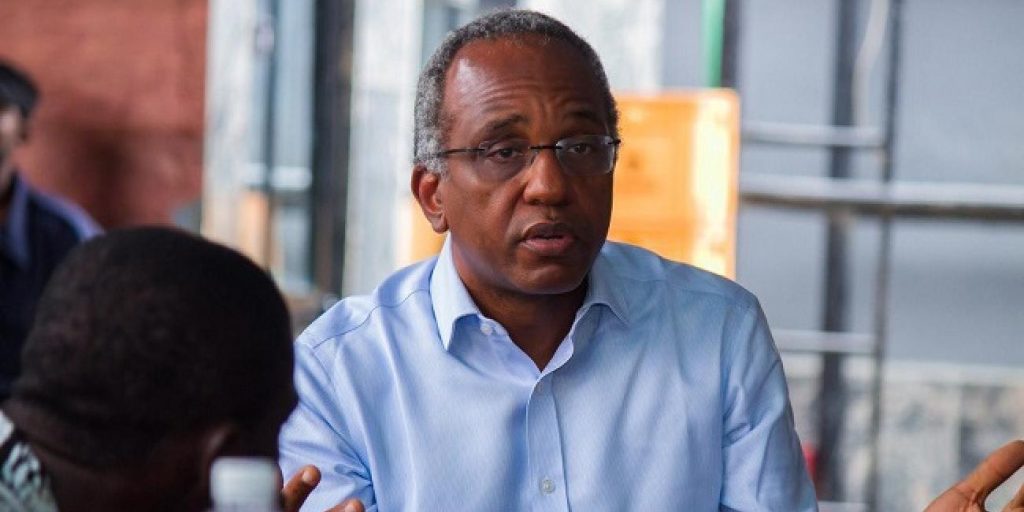
former Lagos State governorship candidate, Funso Doherty, has faulted the Lagos State Government’s proposed 2026 budget.
He alleged extravagant and questionable spending plans, including over ₦212 million for the purchase of 20 office tables and chairs and more than ₦20 billion for vehicles for members of the Lagos State House of Assembly.
Doherty made the allegations in an open letter dated December 11, 2025, addressed to the Speaker of the Lagos State House of Assembly, over the N4.237 trillion 2026 budget presented by Governor Babajide Sanwo-Olu on November 25, 2025.
In the letter, Doherty accused the state government of “lack of fiscal transparency, probity & discipline,” while highlighting what he described as glaring errors and inflated costs embedded in both the proposed 2026 budget and the current 2025 Appropriation Act.
According to the breakdown cited in the letter, the State House of Assembly budgeted ₦20,665,334,794 for the “purchase of back-up vehicles for forty honorable members, 40 utility buses and 40 official” vehicles. Doherty described the figure as “a colossal appropriation,” adding that it “speaks to a government that is completely disconnected from the people.”
He said the provision “implies a cost of ₦516 million for vehicles for each House of Assembly member,” noting that the spending comes on top of “2024’s actual expenditure of approx. ₦15 billion on motor vehicles.”
Also listed in the budget is ₦212,119,883 by the Office of Public-Private Partnerships for the “purchase of 20 office tables and chairs.”
Doherty described the allocation as “completely unreasonable,” stating that it “implies an average unit price of ₦10.6 million for each chair and table.”
Other expenditures highlighted include ₦4.5 billion for the “purchase & installation of 40 Nos. of 50 KVA generators” for the House of Assembly, ₦6.22 billion for the purchase of 40 properties in Lagos and Abuja, and ₦217 million for a single 13-seater bus for the Parastatals Monitoring Office.
Doherty further criticised the inclusion of ₦186.6 billion under “Consultancy & Professional Fees (Recurrent),” noting that at that level, the figure accounts for “almost 15% of the entire recurrent cost budget of Lagos State.”
He added that “fees paid to Alpha Beta Consulting, about which questions have repeatedly been asked, fall under this line item.”
Beyond specific items, Doherty said the overall 2026 budget figures were already flawed, arguing that the stated recurrent expenditure of ₦2.052 trillion improperly included ₦383 billion in debt repayments, which he said “is a capital and not a recurrent expenditure item,” making the budget “misstated by almost ₦400bn.”
He also pointed out that the sectoral allocations provided added up to only ₦3.4 trillion, far below the proposed total budget of ₦4.237 trillion, warning that “one, or possibly both, of these must therefore be wrong.”
The former governorship candidate contrasted the spending on lawmakers with what he described as chronic under-investment in social sectors.
He noted that combined expenditure on education, health, housing development and water supply amounted to just 17% of total government spending.
He described it as “alarming” that the 2025 capital expenditure for the House of Assembly alone exceeded allocations for the entire health and education sectors of Lagos State.
Doherty said the consequences were evident, citing official data showing that “54% of students from Lagos public schools failed WASSCE (West African Senior School Certificate Examination) in 2024,” while large sections of the population remain without adequate housing, potable water and accessible healthcare.
“Propaganda aside; therefore, the evidence is clear,” he said. “After a generation at the helm, and despite the substantial resources expended year after year, the welfare of the people has been neither effectively prioritized, nor actually delivered, by this government.”
He also criticised what he called a “predictable trend of unrealistic projections” in revenue estimates, noting that as of September 2025, actual revenues stood at ₦2.07 trillion against a full-year target of ₦3.37 trillion.
While acknowledging that a controversial “Special Duties Expenses” line item of over ₦200 billion did not reappear and that foreign currency borrowing appeared to be moderated, Doherty called on the legislature to compel greater openness.
He urged that “the details of the 2026 and subsequent LASG budget proposals [be] made publicly available, as part of the legislative process prior to passage into law.”