
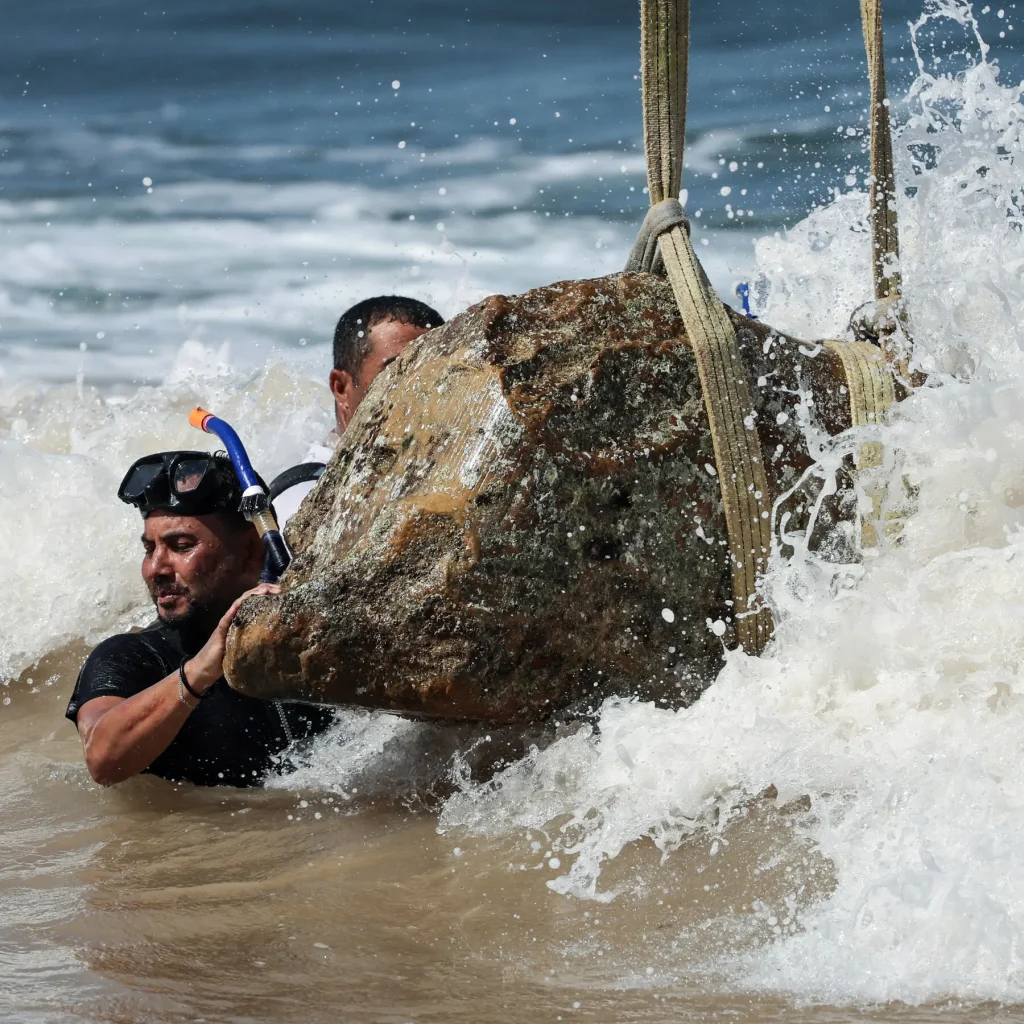
Archaeologists have recovered 2,000-year-old relics from the sunken city of Canopus off Alexandria, shedding light on its scale, culture, and history.
Remnants of the ancient city of Canopus have been recovered from the waters of the Bay of Abukir, Egypt, in a major archaeological operation, officials confirmed last week.
Cranes lifted statues, coins, tools, and a sphinx dating back 2,000 years, drawing cheers from onlookers as politicians and archaeologists watched from the shore. The discoveries, long buried under silt and clay, offer new insights into Canopus, a city once famed as both a religious hub and a Roman-era holiday destination.
Damian Robinson, director of the Oxford Center for Maritime Archaeology, said the exploration marked the first detailed study of the bay’s western side. “Now what we have is a much more complete view of the city,” he said. “It’s actually much bigger, perhaps, than we previously thought. It is really exciting.”
Egypt’s tourism and antiquities minister, Sherif Fathi, said the relics were part of cities lost to earthquakes, land subsidence, and rising seas between the 6th century B.C. and 4th century A.D. “There’s a lot underwater, but what we’re able to bring up is limited; it’s only specific material according to strict criteria,” he said, citing UNESCO regulations.
The finds will undergo a year-long desalination process before eventual display. While absent from the Nov. 1 opening of Egypt’s Grand Egyptian Museum, they add to a growing record of underwater discoveries preserved by the bay’s conditions.
THIS WAS ORIGINALLY PUBLISHED ON NEW YORK TIMES