
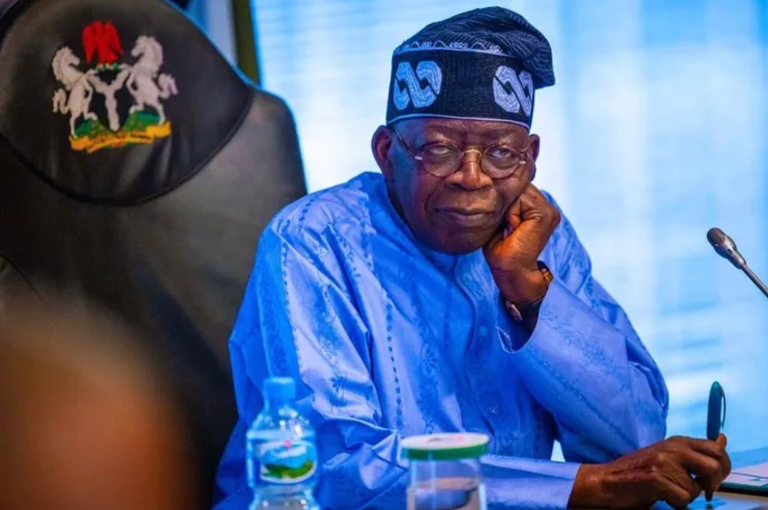
President Bola Ahmed Tinubu is strategically mobilizing celebrities, socialites, and state governors through the City Boys Movement—a youth-driven political platform led by his son Seyi Tinubu—to secure grassroots support and elite backing ahead of the 2027 presidential election, though critics question whether celebrity endorsements can sway hungry and unemployed Nigerians suffering under his economic policies.
by Nij Martin
As Nigeria counts down to the 2027 general elections, President Bola Ahmed Tinubu is deploying a sophisticated political machinery that blends celebrity influence, elite patronage, and grassroots mobilization. At the heart of this strategy is the City Boys Movement, a youth-driven political platform championed by Seyi Tinubu, the president’s son, which has successfully recruited high-profile socialites, entertainers, and business moguls to rally support for the president’s re-election bid.
The Celebrity Brigade
The list of entertainers and socialites backing Tinubu reads like a who’s who of Nigerian pop culture. Obinna Iyiegbu (Obi Cubana), Pascal Okechukwu (Cubana Chief Priest), Cletus Oragwa (Zenco), Yul Edochie, Emmanuel Philip, Bolanle Ninilowo, Zack Orji, Adeniyi Johnson, and comedian Seyi Law have all publicly declared their support for the president. Obi Cubana has been appointed South-East Zonal Coordinator of the City Boys Movement, with a clear mandate: mobilize young Igbo entrepreneurs, galvanize their support, and align them strategically behind Tinubu’s 2027 re-election bid.
This is not Tinubu’s first dance with celebrity endorsements. Prior to the 2023 presidential election, entertainers like Seyi Law, Eniola Badmus, Toyin Abraham, Olaiye Igwe, and Lege Miami threw their weight behind the former Lagos State governor. The strategy worked then, and Tinubu appears to be doubling down on it now.
The Architecture of Influence
According to Comrade Engr Dr Eragbe Anslem Aphimia, National Youth Leader of the Labour Party, Tinubu “understands something about people and their needs and is good at cultivating people in line with his own aspirations, desires and want.” Aphimia notes that the president has successfully infiltrated almost all sectors: security, INEC, political parties, state governments, legislatures, judiciary, and entertainment, bringing people from different sectors into believing in his 2027 presidential realization.
“PBAT was the most formidable opposition leader in Nigeria from 1999–2023 before he became President of Nigeria,” Aphimia explained. “He led the most formidable opposition against incumbent presidents and also saw to it that a sitting president was defeated at the polls. He came to power by that same scheme which many people did not understand and may not understand till after the 2027 general elections.”
The City Boys Movement is not a casual social club—it is a carefully structured political machine. Founded in 2022 as a youth advocacy and mobilization platform supporting Tinubu’s presidential ambition, the movement operates across all 774 local governments, focusing on political education, grassroots engagement, and policy advocacy tied to the Renewed Hope agenda. What makes it particularly potent is its refusal to dissolve after victory in 2023. Instead, it institutionalized itself, deploying national executives, state leaders, local coordinators, and ward canvassers across the country.
APC chieftain Eze Chukwuemeka Eze describes the movement’s architecture: “State-aligned politicians defend federal policies locally. However, if Renewed Hope is the ideological umbrella, the foot soldiers of that umbrella are movements like the City Boy structure, arguably one of the most organized youth-driven political mobilizations in contemporary Nigerian politics.”
The Elite Patronage Model
What truly distinguishes the City Boys Movement is its patronage and elite backing. Seyi Tinubu, as grand patron, symbolizes how political succession, youth mobilization, and elite financing intersect within the same movement. Financial empowerment programmes, grants, and youth interventions tied to the movement have been deployed in several states, blending political loyalty with socio-economic incentives.
“When empowerment meets political branding, what you get is not just supporters; you get beneficiaries with electoral memory,” Eze observed.
Beyond the celebrity mobilization, Tinubu has also secured the backing of almost all state governors. The APC has strengthened its foothold with the defection of governors elected on the platform of the main opposition Peoples Democratic Party (PDP). Umo Eno (Akwa Ibom), Sheriff Oborevwori (Delta), Duoye Diri (Bayelsa), and Peter Mbah (Enugu) have all moved to the APC, with rumors suggesting Taraba State governor Agbu Kefas may follow suit, bringing the tally to 30 state governors backing President Tinubu.
The Critics Speak
Not everyone is impressed. Dr. Adetokunbo Pearse, a public affairs analyst and member of the PDP National Presidential Campaign Council, argues that Tinubu’s government caters to the interest of the privileged class. “If Cubana and the City Boy Movement want to entrench themselves in the privileged class, it only makes sense for them to associate themselves with Tinubu’s campaign. Unfortunately for them however, they represent a very small percentage of the voting public—probably 2% of the electorate of the South East geopolitical zone,” Pearse told DAILY POST.
“It is difficult to see how their celebrity status will convince the hungry and unemployed citizens of Nigeria to vote for the reelection of Tinubu, who in his first term as President has made life worse for them than ever before. Tinubu has deepened their poverty, increased the rate of unemployment, increased the cost of living beyond affordability, and made their life unsafe.”
Pearse argues that the general public in Igboland would rather listen to Nnamdi Kanu than to Cubana and his City Boys Movement, knowing that Kanu has always stood for the common man, while Cubana and co are only interested in what they can benefit and how they can protect their wealth. “Entertainers are paid to entertain, not to lecture on life’s choices,” he added, citing the example of a Lagos State PDP deputy governorship candidate in 2023 who boasted 15 million Facebook followers but didn’t garner 15,000 votes.
APC chieftain Eze Chukwuemeka Eze also questions the movement’s legitimacy, calling it “a movement against the masses of Nigeria who are being punished with poverty, insecurity and hunger by the evil policies of President Tinubu.” He references the emergence of a “Village Boy Movement” as a counter-force that will check and curtail whatever agenda the City Boys Movement promotes.
Can Celebrity Influence Win Elections?
The central question remains: In a nation grappling with unprecedented economic hardship, can celebrity endorsements and elite mobilization translate into electoral victory? Tinubu’s camp is betting that a combination of celebrity influence, grassroots mobilization, financial empowerment tied to political loyalty, and gubernatorial support will create an unstoppable political machine.
Critics, however, argue that hungry Nigerians will not be swayed by the endorsements of wealthy socialites who are perceived as beneficiaries of the very system that has impoverished the masses. The true test will come in 2027, when voters will decide whether they align with the City Boys—or whether they prefer to remain Village People, voting with their stomachs and their wallets rather than with celebrity recommendations.
One thing is certain: President Tinubu has never been a politician who leaves things to chance. His track record as Nigeria’s most formidable opposition leader before becoming president demonstrates his understanding of political machinery and mobilization. Whether this strategy will overcome the widespread economic hardship Nigerians are experiencing remains to be seen. But for now, the City Boys are marching, the celebrities are singing, and the governors are saluting—all in anticipation of 2027.
NEWS NOW:
- Borno: 104 soldiers missing after Boko Haram attack — Army calls them deserters, freezes their accounts
- First major NYSC shake-up since 1973: Passing out parade gone, six weeks orientation approved
- 16-year-old becomes Nigeria’s youngest chartered accountant
- Ford rehires over 300 engineers after AI falls flat on quality checks