
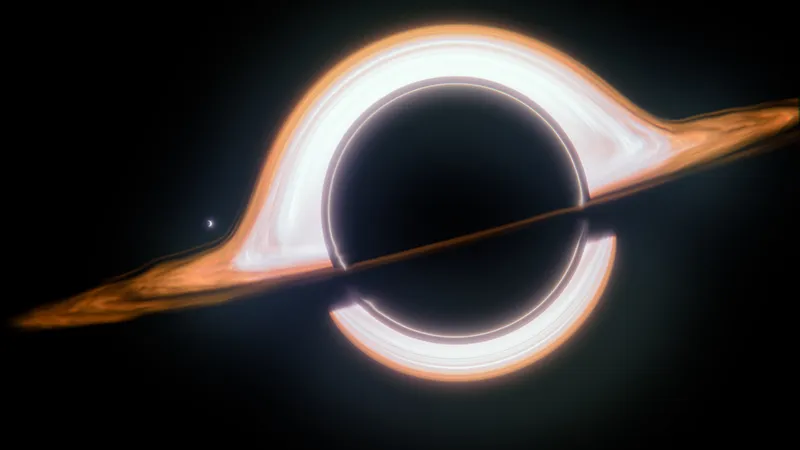
Black holes remain among the universe’s most enigmatic objects, continuing to challenge fundamental physics despite decades of research. Their extreme gravitational fields, formed from collapsed massive stars, prevent even light from escaping. This creates significant problems when analyzing them through thermodynamics, as black holes appear to destroy information when matter crosses their event horizons—a violation of quantum mechanics’ basic principles.
Stephen Hawking demonstrated that black holes emit radiation at their boundaries, leading to what physicist Gerard ‘t Hooft called the holographic principle. This concept suggests information about a black hole’s three-dimensional interior is encoded on its two-dimensional surface, “like a hologram,” potentially resolving the information paradox. French astrophysicist Jean-Pierre Luminet explains: “For an external observer, information about the entropy of the black hole, once borne by the three-dimensional structure of the objects that have crossed the event horizon, seems lost. But on this view, the information is encoded on the two-dimensional surface of a black hole.”
Some physicists have extended this theory to propose our entire universe exists within a larger universe’s black hole, with reality emerging from processes at the boundary. Supporting this idea, the universe’s observable Hubble Radius closely matches its theoretical Schwarzschild radius. However, standard physics still best describes observed phenomena, and this radical theory lacks compelling predictive evidence beyond current understanding.
NEWS NOW:
- I’m Nigeria’s first gov to rule for eight years without personal house – Aregbesola
- Tinubu spending on US lobbyists instead of addressing ‘Christian genocide’ – Senator Ted Cruz
- How Bauchi inmate runs car theft ring from prison
- Tracka exposes N30.15bn budget for palaces, churches, mosques via unrelated agencies