
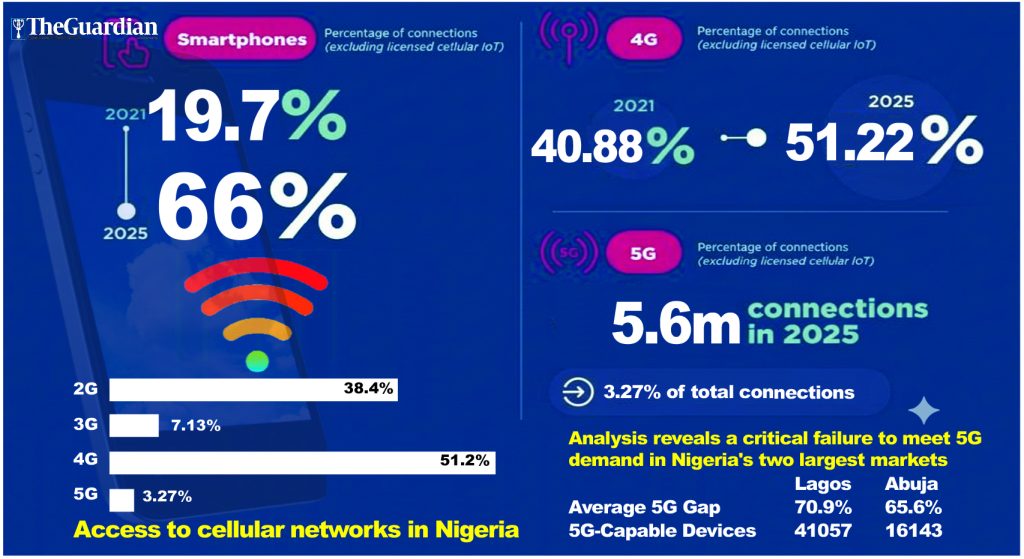
Three years after launch, 5G penetration in Nigeria remains below four percent, limited to wealthy users in major cities.
Three years after its rollout, Nigeria’s fifth-generation (5G) network remains accessible only to a small segment of wealthy users in major cities, despite its promise of nationwide digital transformation.
According to data from the Nigerian Communications Commission (NCC), 5G penetration stands at just 3.2 percent, with only about 5.6 million users out of 172 million active connections. The Guardian reports that the high cost of compatible devices—often above ₦170,000—has hindered mass adoption, worsened by the absence of local manufacturing or assembly plants.
“People are not getting benefits for the money spent,” said Chief Deolu Ogunbanjo, President of the National Association of Telecom Subscribers. “These operators are just milking Nigerians.”
MTN and Airtel have invested heavily in expanding coverage, but the network remains largely confined to Lagos, Abuja, and a few urban centres. Experts warn that without cheaper devices and wider reach, 5G risks deepening Nigeria’s digital divide.
NEWS NOW: