
THE TELEGRAPH ON YAHOO SPORTS
For once, Pep Guardiola’s response to a miniature crisis has been to free himself of his obsessions. Rather than letting an opening sequence of two league defeats in three tip him into turmoil, he has found refuge in alternative passions, flitting from the US Open men’s final in New York to Wentworth 72 hours later, supporting his friend Tommy Fleetwood. The last time he drifted towards such distractions in the midst of a season was in 2012, when he marked his post-Barcelona sabbatical by giving a speech in Europe’s Ryder Cup team room at the invitation of José María Olazábal, helping to ignite the “Miracle at Medinah”.
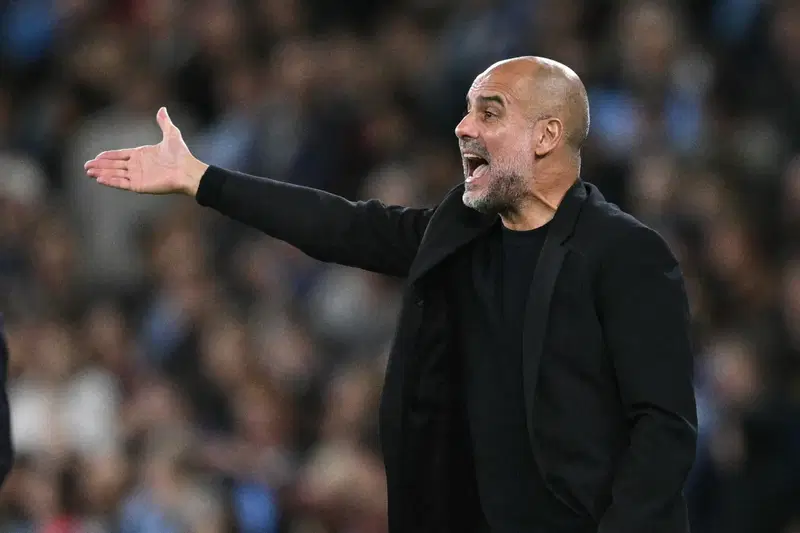
True to form, he maintained his intensity even on the fairways this week, restless to offer swing advice to the newly minted FedEx Cup champion. “You lifted your head,” he told Fleetwood after one tee shot. But the very fact that Guardiola is seeking solace beyond Manchester City provides a clue as to his shifting mentality. At 54, unsettled by the inquest into his team’s ragged form and the never-ending saga of the 130 charges, he has the demeanour of somebody whose heart is not fully in the fight. In the moments that followed losing at Brighton, he lacked the energy to berate the officials or his own players, wandering across the pitch as if in a haunted daze.
‘Tactics don’t work like they used to’
After nine years and two months, Guardiola is already the fourth longest-serving manager in Premier League history. But amid the 18 trophies and countless tactical masterstrokes, there is the nagging question of whether he has bungled a crucial call, spurning the chance to bow out at the summit. The unprecedented feat last summer of a fourth straight title gave him the perfect “mic drop”, an opportunity to be defined purely by a streak that even Sir Alex Ferguson could not achieve. Instead, he is presiding over a distressing transition from majesty to mayhem, with City vulnerable to collapses so sudden they would imperil managers of lesser pedigree.
While he could have emulated Jürgen Klopp, stepping away on the pretext that the fuel gauge was flashing red, Guardiola increasingly invites parallels with Arsène Wenger as a figure who has outstayed his welcome. The mediocrity that crept in during the autumn of Wenger’s reign disfigured his body of work, condemning him to be remembered less as the architect of the 2003-04 Invincibles than as, to quote his fiercest critics, an analogue manager in a digital age. The same danger stalks Guardiola, who has gone from being heralded for his aesthetic sophistication – enshrined in a desire for his side to play a “thousand, million passes” – to cursed for his obstinacy. Lose in Sunday’s Manchester derby and we will not be far from a repeat of last season’s tailspin, which reached its nadir with City fans booing a chaotic Champions League performance against Feyenoord.
Yes, the campaign is only three games old, but no team since United 32 years ago have suffered two defeats in that period and gone on to be anointed champions. When you include City’s unravelling against Al-Hilal at the Club World Cup, you see that the hangover from May, when Guardiola absorbed the fallout from only his second trophyless season at the Etihad, has left a bleak shadow. It is not simply that more opponents have cracked the City code – responding to a systematised, possession-based style with rapid counter-attacks – but that Guardiola himself no longer casts quite the same spell. And he knows it, admitting after this year’s humbling by Real Madrid that his “tactics don’t work like they used to”.
Can he redraw the template? Can he cement his reputation as a towering genius of the age by reinventing his entire philosophy, introducing a high press and more direct lines of attack at the expense of his almost pathological preoccupation with keeping the ball? So far, the signs are inauspicious. Tottenham’s Thomas Frank and Brighton’s Fabian Hürzeler have both cut him down to size with their emphasis on fast breaks, exploiting vulnerabilities in a revamped City defence that still looks anything but cohesive. If United find success in targeting the same weaknesses, Guardiola’s golden record will lose a little of its lustre.
The heart of the treble-winning team he assembled two years ago has been hollowed out, with 15 of the 23 he picked for the Champions League final against Inter Milan having departed. Bernardo Silva is highly likely to join them next summer, while John Stones, at 31, will struggle to continue meeting his manager’s remorseless physical demands. It is a moot point as to whether the latest recruits represent appreciable upgrades, with Abdukodir Khusanov toiling to fill the void left by Kyle Walker and Nico González yet to stake his claim as the heir to Rodri. The calming, dominant presence in goal of Gianluigi Donnarumma can scarcely come soon enough. Even so, the potential peak of this team – the fifth youngest in the Premier League, with an average age of 24.8 – lies beyond Guardiola’s probable departure. Whereas Klopp left Anfield safe in the knowledge that he had created a second great Liverpool vintage, his old nemesis has no such certainty at City.
In one sense, we should resist concern about him. Guardiola is dropping plenty of hints about where life will take him after his City contract expires in 2027, explaining that he is committed to mastering French, picking up his golf clubs more often, and learning how to cook properly. One of his best therapies, he told Spanish chef Dani García recently, is to collect his thoughts for the next match over dinner at Tast, his Catalan restaurant in Manchester, with golf on television in the background. Perhaps that is why he has re-established contact with Fleetwood this week. Perhaps there is nothing like a few six-irons to balm the soul.
There is a feeling, though, that Guardiola’s problems run too deep to be resolved during a single international break. Not for the first time, he seems exhausted by the pursuit of perfection. This impression arrived after four years at Barcelona, while at City it has taken almost a decade. Do not forget the lesson he learnt from his friendship with Garry Kasparov, the chess grandmaster: that while Kasparov could theoretically outplay Magnus Carlsen, the finest player of the next generation, in a contest lasting only a couple of hours, such extreme effort could not last over a marathon match. Guardiola must today confront a similar reckoning, conscious that his competitors have caught up but unsure whether he has the stamina to outsmart them afresh.
THIS ARTICLE ORIGINALLY APPEARED IN YAHOO SPORTS
NEWS NOW: