
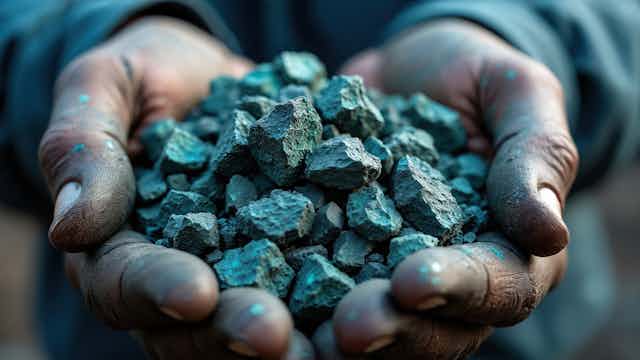
A US-brokered peace deal between the Democratic Republic of Congo (DRC) and Rwanda, signed in June 2025, links mineral access with vague security assurances from Washington.
A US-brokered peace deal between the Democratic Republic of Congo (DRC) and Rwanda binds the two African nations to a worrying arrangement: one where a country signs away its mineral resources to a superpower in return for opaque assurances of security.
The peace deal, signed in June 2025, aims to end three decades of conflict between the DRC and Rwanda.
A key part of the agreement binds both nations to developing a regional economic integration framework. This arrangement would expand cooperation between the two states, the US government and American investors on “transparent, formalized end-to-end mineral chains”.
Despite its immense mineral wealth, the DRC is among the five poorest countries in the world. It has been seeking US investment in its mineral sector.
The US has in turn touted a potential multi-billion-dollar investment programme to anchor its mineral supply chains in the traumatised and poor territory.
The peace that the June 2025 deal promises, therefore, hinges on chaining mineral supply to the US in exchange for Washington’s powerful – but vaguely formulated – military oversight.
The peace agreement further establishes a joint oversight committee – with representatives from the African Union, Qatar and the US – to receive complaints and resolve disputes between the DRC and Rwanda.
But beyond the joint oversight committee, the peace deal creates no specific security obligations for the US.
The relationship between the DRC and Rwanda has been marred by war and tension since the bloody First (1996-1997) and Second (1998-2003) Congo wars. At the heart of much of this conflict is the DRC’s mineral wealth. It has fuelled competition, exploitation and armed violence.
This latest peace deal introduces a resources-for-security arrangement. Such deals aren’t new in Africa. They first emerged in the early 2000s as resources-for-infrastructure transactions. Here, a foreign state would agree to build economic and social infrastructure (roads, ports, airports, hospitals) in an African state. In exchange, it would get a major stake in a government-owned mining company. Or gain preferential access to the host country’s minerals.
We have studied mineral law and governance in Africa for more than 20 years. The question that emerges now is whether a US-brokered resources-for-security agreement will help the DRC benefit from its resources.
Based on our research on mining, development and sustainability, we believe this is unlikely.
This is because resources-for-security is the latest version of a resource-bartering approach that China and Russia pioneered in countries such as Angola, the Central African Republic and the DRC.
Resource bartering in Africa has eroded the sovereignty and bargaining power of mineral-rich nations such as the DRC and Angola.
between the Democratic Republic of Congo (DRC) and Rwanda binds the two African nations to a worrying arrangement: one where a country signs away its mineral resources to a superpower in return for opaque assurances of security.
The peace deal, signed in June 2025, aims to end three decades of conflict between the DRC and Rwanda.
A key part of the agreement binds both nations to developing a regional economic integration framework. This arrangement would expand cooperation between the two states, the US government and American investors on “transparent, formalized end-to-end mineral chains”.
Despite its immense mineral wealth, the DRC is among the five poorest countries in the world. It has been seeking US investment in its mineral sector.
The US has in turn touted a potential multi-billion-dollar investment programme to anchor its mineral supply chains in the traumatised and poor territory.
The peace that the June 2025 deal promises, therefore, hinges on chaining mineral supply to the US in exchange for Washington’s powerful – but vaguely formulated – military oversight.
The peace agreement further establishes a joint oversight committee – with representatives from the African Union, Qatar and the US – to receive complaints and resolve disputes between the DRC and Rwanda.
But beyond the joint oversight committee, the peace deal creates no specific security obligations for the US.
The relationship between the DRC and Rwanda has been marred by war and tension since the bloody First (1996-1997) and Second (1998-2003) Congo wars. At the heart of much of this conflict is the DRC’s mineral wealth. It has fuelled competition, exploitation and armed violence.
This latest peace deal introduces a resources-for-security arrangement. Such deals aren’t new in Africa. They first emerged in the early 2000s as resources-for-infrastructure transactions. Here, a foreign state would agree to build economic and social infrastructure (roads, ports, airports, hospitals) in an African state. In exchange, it would get a major stake in a government-owned mining company. Or gain preferential access to the host country’s minerals.
We have studied mineral law and governance in Africa for more than 20 years. The question that emerges now is whether a US-brokered resources-for-security agreement will help the DRC benefit from its resources.
Based on our research on mining, development and sustainability, we believe this is unlikely.
This is because resources-for-security is the latest version of a resource-bartering approach that China and Russia pioneered in countries such as Angola, the Central African Republic and the DRC.
Resource bartering in Africa has eroded the sovereignty and bargaining power of mineral-rich nations such as the DRC and Angola.
Further, resources-for-security deals are less transparent and more complicated than prior resource bartering agreements.
In a world being reshaped by global interests in critical minerals, African states must not underestimate the strategic value of their mineral resources. They hold considerable leverage.
But leverage only works if it is wielded strategically. This means:
investing in institutional strength and legal capacity to negotiate better deals
demanding local value creation and addition
requiring transparency and parliamentary oversight for minerals-related agreements
refusing deals that bypass human rights, environmental or sovereignty standards.
Africa has the resources. It must hold on to the power they wield.
THIS ARTICLE ORIGINALLY APPEARED AT THE CONVERSATION
NEWS NOW: